Our Story
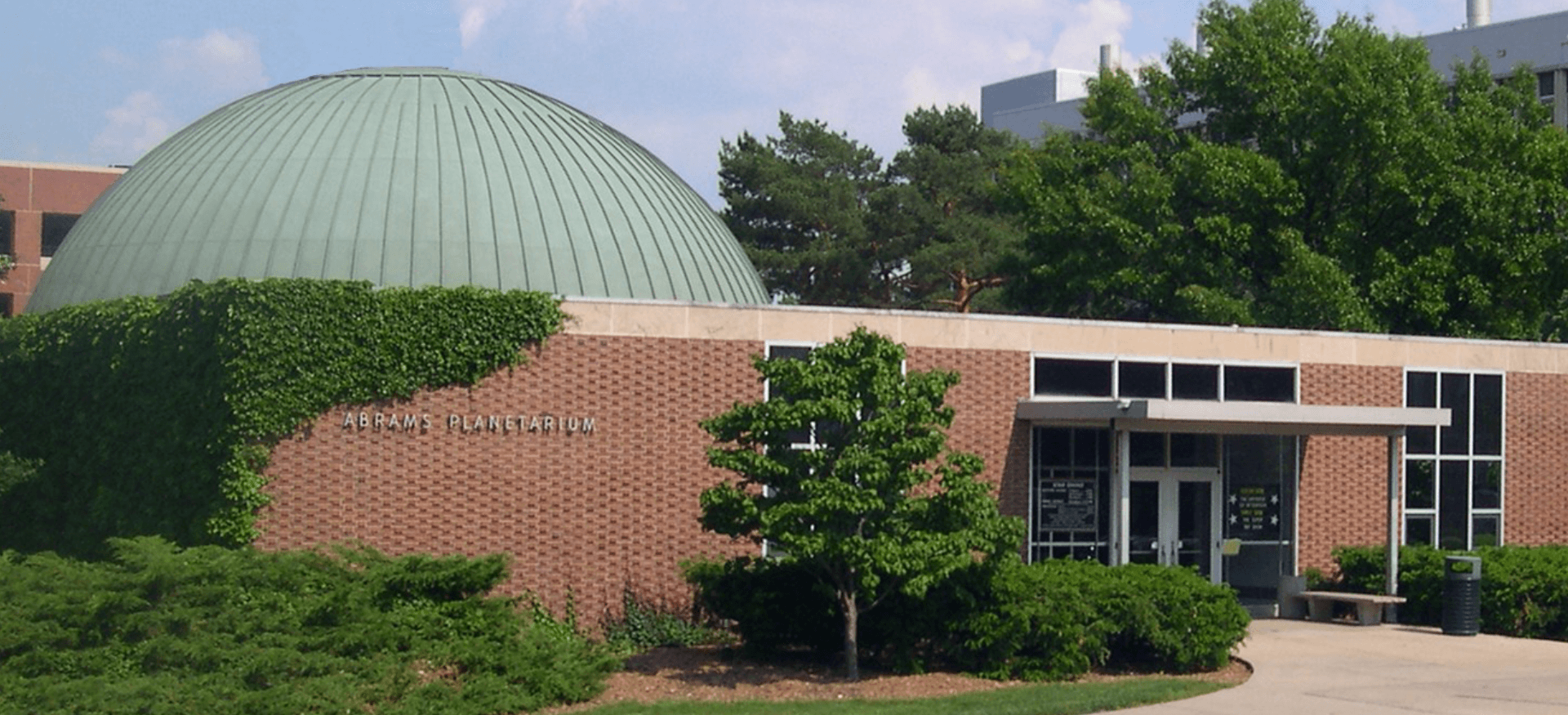 The Talbert and Leota Abrams Planetarium, located on the beautiful Michigan State University campus, serves as an astronomy and space science education resource center for central
Michigan. The planetarium is an outreach unit of the Department of Physics and Astronomy, and as such, we support astronomy teaching for the general public through public
shows, field trips, portable planetarium, outreach, and other programs.
The Talbert and Leota Abrams Planetarium, located on the beautiful Michigan State University campus, serves as an astronomy and space science education resource center for central
Michigan. The planetarium is an outreach unit of the Department of Physics and Astronomy, and as such, we support astronomy teaching for the general public through public
shows, field trips, portable planetarium, outreach, and other programs.
We also support the MSU campus by hosting MSU astronomy classes and labs. The planetarium also frequently partner with different units to take advantage of our immersive theater to teach about different topics, both with and without overlaps with astronomy. Our planetarium is a flexible learning environment that allows for experimentation that our MSU faculty, staff, and students are welcome to explore.
Our Namesakes - Talbert and Leota Abrams
 The Abrams Planetarium was named in honor of Leota and Talbert "Ted" Abrams, a pioneer
in the field of aerial photography and mapping. Ted Abrams was born on August 17,
1896 in Tekonsha, Michigan. While a child he read about the flights of the Wright
brothers and was inspired to become a pilot. When he turned 18 he moved to Detroit
and found odd jobs at area airports. The following year was hired as a mechanic at
the Benoist Airplane Company in Ohio. Soon after he moved to Buffalo, New York where he worked for the Curtiss Aeroplane Company. During his employment there, Abrams learned to fly at the Curtiss Aviation School, and in 1916 was issued his Federation Aeronautique
The Abrams Planetarium was named in honor of Leota and Talbert "Ted" Abrams, a pioneer
in the field of aerial photography and mapping. Ted Abrams was born on August 17,
1896 in Tekonsha, Michigan. While a child he read about the flights of the Wright
brothers and was inspired to become a pilot. When he turned 18 he moved to Detroit
and found odd jobs at area airports. The following year was hired as a mechanic at
the Benoist Airplane Company in Ohio. Soon after he moved to Buffalo, New York where he worked for the Curtiss Aeroplane Company. During his employment there, Abrams learned to fly at the Curtiss Aviation School, and in 1916 was issued his Federation Aeronautique 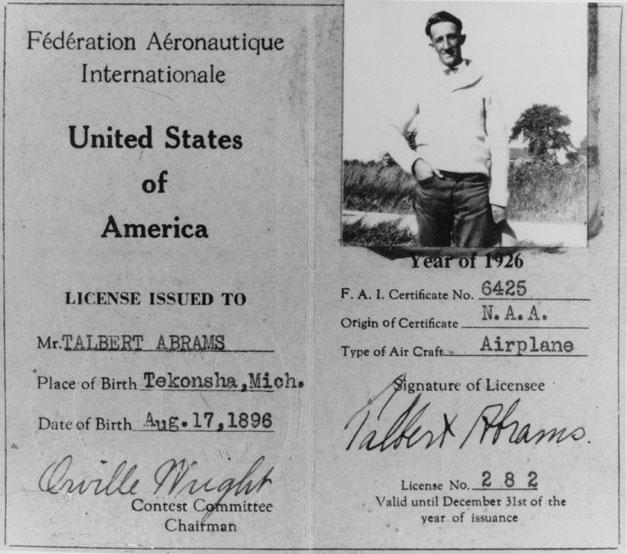 Internationale Pilot's license, number 282, signed by Orville Wright.
In 1917 he enlisted in the Marines and was placed in the Aviation Section and stationed in Pensacola, Florida with the Navy's flying school. After World War I, Abrams stayed in the military, where his squadron, the First Marine Aviation Force, was assigned to patrol duty in the Caribbean. His squadron would take detailed aerial maps of the coast of Haiti, documenting the movements of rebel troops. While completing this assignment Ted Abrams became seriously interested with the development of new techniques of aerial photography.
After he left the military in 1920, Abrams purchased his first airplane, a Curtiss JN-4 Jenny, and formed his own business, the ABC Airline ("Always Be Careful"). He used pictures he had taken from his flights to convince people to buy trips on the plane. However, he soon learned that people would rather purchase his aerial pictures than rides in the airplane.
On January 15, 1923 Ted Abrams married Leota Pearl Fry and they soon moved to Lansing. At this time Abrams bought a new plane, a Standard J-1, and equipped the plane with a homemade camera and formed the Abrams Aerial Survey Corporation. The company soon received many government contracts for aerial photographs. The business was a success and it quickly expanded as Abrams purchased more equipment and planes. He then formed the Abrams Instrument Corporation in order to design better cameras and equipment for his planes.
 In 1937 Ted Abrams formed the Abrams Aircraft Corporation. The purpose of this company was to design and build a better aircraft for aerial
photography. This led to the design and construction of the Abrams Model P-1 Explorer, the first aircraft created for the sole purpose of aerial photography. The plane
saw extensive use up to World War II. Abrams continued to design other planes, including
the "Explorer II", but because of the war, none of these designs were ever built.
In 1937 Ted Abrams formed the Abrams Aircraft Corporation. The purpose of this company was to design and build a better aircraft for aerial
photography. This led to the design and construction of the Abrams Model P-1 Explorer, the first aircraft created for the sole purpose of aerial photography. The plane
saw extensive use up to World War II. Abrams continued to design other planes, including
the "Explorer II", but because of the war, none of these designs were ever built.
During World War II, Ted Abrams placed the Explorer in storage and formed the Abrams School of Aerial Surveying and Photo Interpretation, where he taught photogrammetric engineering to military students. Also during this time the Abrams Instrument Corporation built aerial photographic equipment for the armed forces.
After World War II, Abrams returned back to aerial photography, but with more advanced planes and equipment being developed, the Explorer was no longer needed. The plane was donated in 1948 to the National Air and Space Museum, where it is still housed today, waiting to be refurbished and displayed.
 The Abrams Instrument Corporation was sold to the Curtiss-Wright Corporation in 1961, and with more free time Abrams and his wife traveled the world. Along with
Leota, Ted Abrams has visited 96 countries and is a member of the Circumnavigators
Club, several times traveling around the world. He has visited both the Arctic and
the South Pole, even having a mountain in Antarctica named after him.
The Abrams Instrument Corporation was sold to the Curtiss-Wright Corporation in 1961, and with more free time Abrams and his wife traveled the world. Along with
Leota, Ted Abrams has visited 96 countries and is a member of the Circumnavigators
Club, several times traveling around the world. He has visited both the Arctic and
the South Pole, even having a mountain in Antarctica named after him.
Along with the Circumnavigators Club, he was a member of the Explorers Club of New York, and inducted into both the OX5 Aviation Pioneer's Hall of Fame and the Michigan Aviation Hall of Fame. His love of flying is most notably shown in the Abram's airplane shaped house located in Lansing.
Reference: Pauley, Robert F. "The Abrams Explorer" Skyways: The Journal of the Airplane 1920-1940. No. 61, January 2002.
History of Abrams Planetarium
In the 1960s the United State entered the Space Race with the Soviet Union. The country saw a boom in new planetariums to help get the next generation of scientists and engineers interested in and trained in space sciences. Ted and Leota Abrams donated a significant amount to MSU to for such a space education center in 1962. Abrams Planetarium opened its doors for the first time in 1964, and for over sixty years it has continued to excite and inspire both young and old.
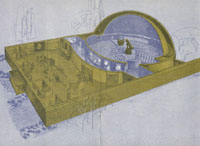 The original building was designed by Ralph Calder Associates of Detroit. It featured
a 60-foot copper dome surrounded by a one-story windowless brick building, in a full
Flemish bond. In 1995, windows were added to give it more character and natural light.
The original building was designed by Ralph Calder Associates of Detroit. It featured
a 60-foot copper dome surrounded by a one-story windowless brick building, in a full
Flemish bond. In 1995, windows were added to give it more character and natural light.
The building consists of three primary sections: the Exhibit Hall, the Blacklight Gallery, and the Sky Theater. Each part of the building has been renovated since its original construction, with each change representing an improvement in technology and scientific knowledge.
The Exhibit Hall
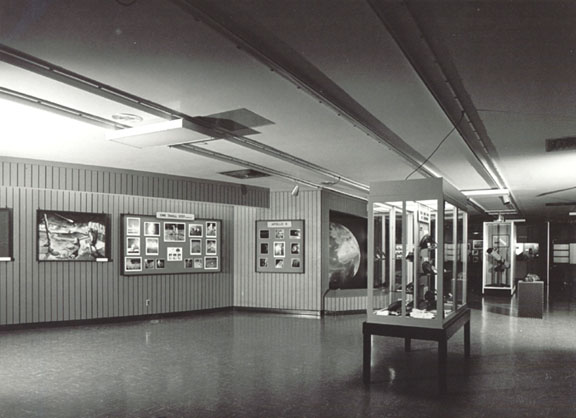 The entrance of the Abrams Planetarium opens directly into the Exhibit Hall, an area
approximately 3,000 square feet in size and devoted to a series of exhibits, which
are designed to supplement the demonstrations given in the Sky Theater.
The entrance of the Abrams Planetarium opens directly into the Exhibit Hall, an area
approximately 3,000 square feet in size and devoted to a series of exhibits, which
are designed to supplement the demonstrations given in the Sky Theater.
The hall also serves as an assembly area for visitors and students who are waiting to attend a show, a space to set up tables and chairs for events, and it contains a gift counter so visitors can purchase a souvenir.
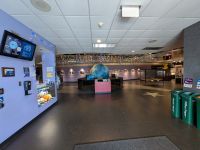 The Exhibit Hall has undergone renovations over the year in order to modernize its
appearance. In the late 1990s, the ceiling was redesigned. A new floor was added in
the early 200s. Prominent displays such as the Earth and moon globes have been repositioned.
Updated displays include a wall of photos highlighting some of the most stunning astronomical
images taken in recent years and student-led projects.
The Exhibit Hall has undergone renovations over the year in order to modernize its
appearance. In the late 1990s, the ceiling was redesigned. A new floor was added in
the early 200s. Prominent displays such as the Earth and moon globes have been repositioned.
Updated displays include a wall of photos highlighting some of the most stunning astronomical
images taken in recent years and student-led projects.
Meteorites
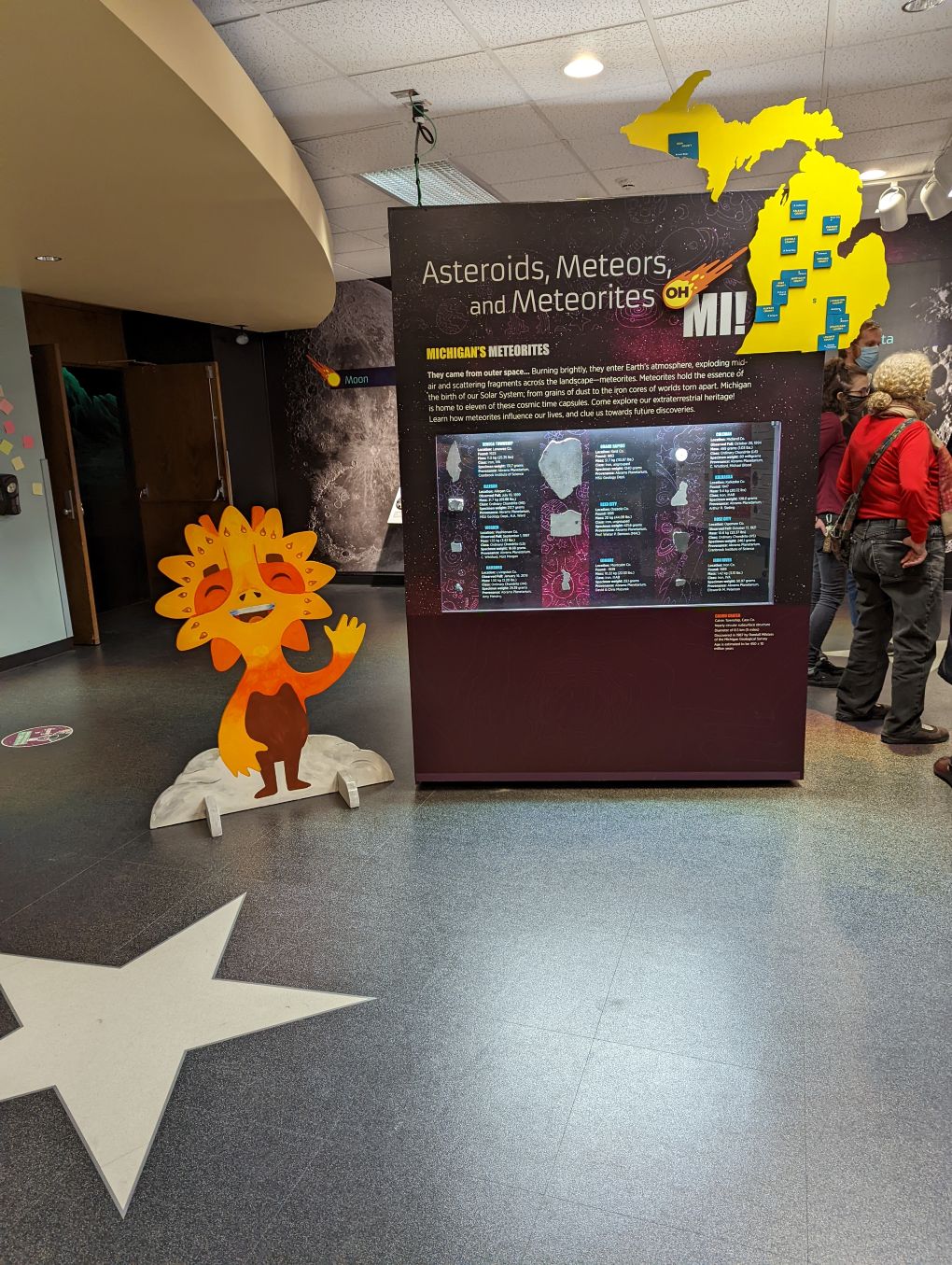
The second director of Abrams Planetarium, Von del Chamberlain, researched meteorites. During his tenure he curated an impressive collection fo meteorites that were on display. They were later taken off display during one of the exhibit hall renovations. In 2021, with grants from the Institute for Museum and Library Services and the Dart Foundation, the exhibit "Asteroids, Meteors and Meteorites, Oh MI" opened. This new exhibiit features the entire collection as well as some new additions. Of particular note is our Michigan Meteorite cabinet that features a specimen from every named meteorite found in our state.
Blacklight Gallery
 As part of the planetarium presentation, the visitor is admitted to the Blacklight
Gallery of astronomical paintings. This is a curving gallery which leads to the Sky
Theater. The large paintings, created in fluorescent paints and lit by ultraviolet
lights, are hung from the black walls of the gallery.
As part of the planetarium presentation, the visitor is admitted to the Blacklight
Gallery of astronomical paintings. This is a curving gallery which leads to the Sky
Theater. The large paintings, created in fluorescent paints and lit by ultraviolet
lights, are hung from the black walls of the gallery.
The colors glow brilliantly supplying a muted light in the gallery which allows the visitor's eyes to become accustomed to the darkness of the theater. While viewing the paintings, the visitor feels that he is standing on a platform, gazing into infinite space.
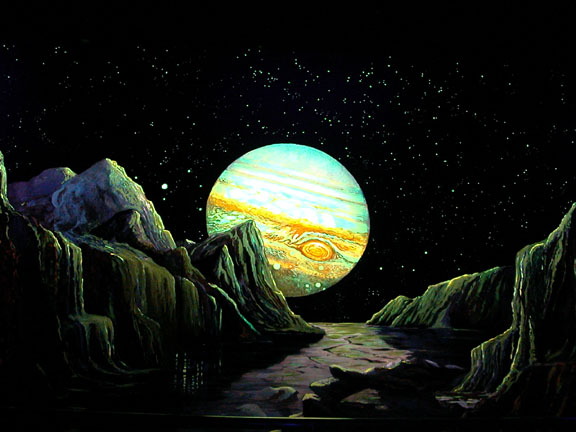 Most painting are original to the building and were painted. 1964. The original images
found within the Blacklight Gallery have been updated several times in order to keep
up with the ever increasing knowledge gained from astronomical science. Since our
opening, additional paintings were added that related to the Apollo 11 moon landing
that occurred in 1969 and the Mariner probe that visited Mars in the 1970s.
Most painting are original to the building and were painted. 1964. The original images
found within the Blacklight Gallery have been updated several times in order to keep
up with the ever increasing knowledge gained from astronomical science. Since our
opening, additional paintings were added that related to the Apollo 11 moon landing
that occurred in 1969 and the Mariner probe that visited Mars in the 1970s.
Sky Theater
 The Sky Theater is surrounded by a hemispherical projection dome 50 feet in diameter.
The dome is made of white-painted, perforated aluminum and serves as the projection
screen the various projectors over the years.
The Sky Theater is surrounded by a hemispherical projection dome 50 feet in diameter.
The dome is made of white-painted, perforated aluminum and serves as the projection
screen the various projectors over the years.
The Sky Theater was known as the Planetarium Chamber when the planetarium first opened. It originally housed the Spitz ISTP projector. This was an opto-mechanical projector that sat in the middle of the theater. It projected light through tiny holes that represented the night sky onto the theater and rotated on several axes to simulate celestial motions. This original projector is still on display in the Biomedical and Physics Science building on MSU's campus. We also have a spare hemisphere with the pinholes installed over a light in our exhibit hall.
Renovations in 1994 brought in the Digistar II star projector along with added slide
and video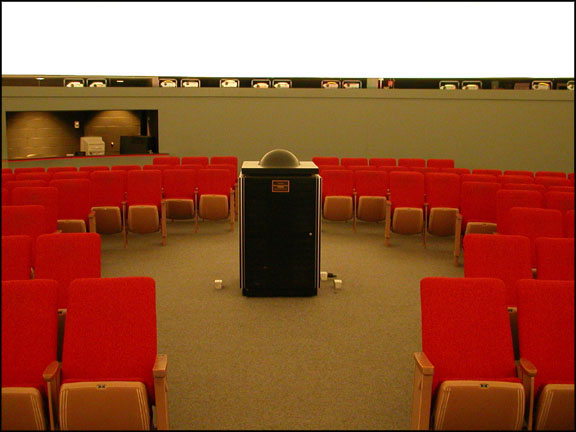 projectors to the theater. The new digital projector was a box in the center of the
theater with a massive curved lens to project on the dome. It allowed for3D models
and was the first time we could show models of the solar system and the Milky Way
from a bird's eye view. It could only project green light, but at least it was the
appropriate color for MSU.
projectors to the theater. The new digital projector was a box in the center of the
theater with a massive curved lens to project on the dome. It allowed for3D models
and was the first time we could show models of the solar system and the Milky Way
from a bird's eye view. It could only project green light, but at least it was the
appropriate color for MSU.
In 2014 the system was again upgraded in the Digistar 5 planetarium system. This system uses two full color digital projectors to cover the dome that sit around the edge of the theater. The software has continued to improve and we currently run Digistar 7. This system allows for far more flexibility in projecting data sets, volumetric models, planets, as well as 360-images and videos, interactive games. It has become quite an immersive suite that allows for incredible levels of customization.
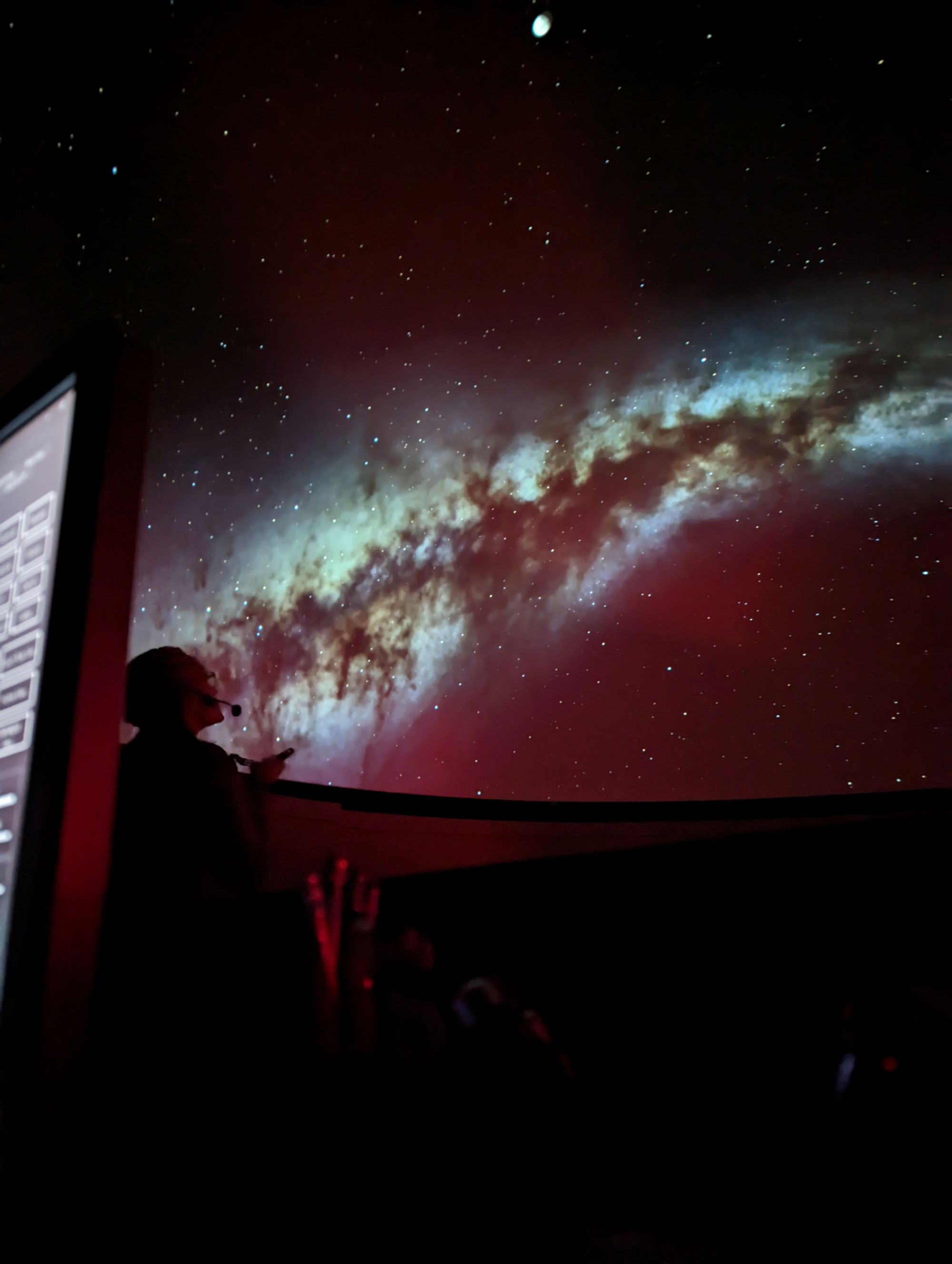 One hundred and forty upholstered, theater-type seats are arranged on the carpeted
floor of the theater. The tilt of the seats varies from row to row, permitting the
entire audience to view the same portion of the projection dome. The Control Console,
located in the rear of the theater, is the control point for the images and sounds
presented during the shows. Ringing the theater is a projection area which allows
for the placement of the Digistar video projectors and other instruments used during
the presentations.
One hundred and forty upholstered, theater-type seats are arranged on the carpeted
floor of the theater. The tilt of the seats varies from row to row, permitting the
entire audience to view the same portion of the projection dome. The Control Console,
located in the rear of the theater, is the control point for the images and sounds
presented during the shows. Ringing the theater is a projection area which allows
for the placement of the Digistar video projectors and other instruments used during
the presentations.
Our Mascot FeNi

FeNi joined our team as our mascot when our meteorite exhibit opened in 2021. FeNi is a modeled after an oriented meteorite, which is a rock that does not tumble when it falls and it ends up with a smooth cone shape. FeNi's name comes from the symbols for the elements iron (Fe) and Nickel (Ni) as these are the two of the most commonly found elements in meteorites.