About the Sky Calendar
Sample Issue
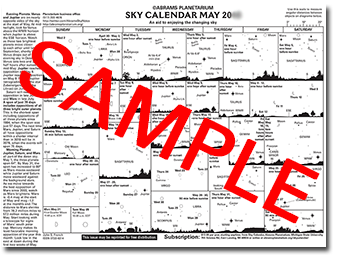
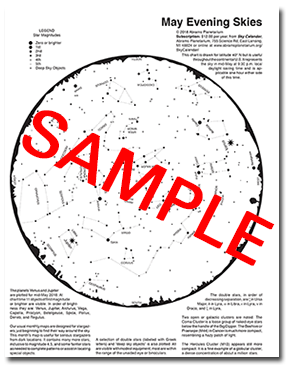
We release the May issue each year for free in honor of Astronomy Day. Click the images below to download the printable PDF of the front and back of the May 2026 issue.
Overview
The Abrams Planetarium Sky Calendar promotes skywatching for people of all ages. As its name implies, the sheet for each month takes the form of a calendar. Diagrams in the boxes invite the reader to track the moon's rapid motion past the planets and bright stars of the zodiac, as well as to follow the more leisurely pace of the planets in their gatherings with bright stars and other planets. The reverse side consists of a simplified star map of the month's evening sky. The sky maps are designed for use at a convenient time in mid-evening, for a latitude useful for the entire continental Unites State(40 degrees north).
The Sky Calendar has evolved into one of the nation's most highly illustrated, easy-to-follow guides to sky events. Not only is it enjoyed by thousands of paid subscribers, but it is used (with permission) by classroom teachers with their students, by planetariums and astronomy clubs, and by park interpreters for audiences at sky talks. Both the sky map (on the reverse side) and the calendar have appeared in issues of Science and Children, a journal of the National Science Teachers Association.
The Sky Calendar has received awards for excellence in educational journalism from the Educational Press Association of America. It has since had favorable reviews not only from astronomical publications, such as Sky & Telescope and Mercury, but also from School Library Journal and Scientific American. In his review column in the latter, Phillip Morrison determined it to be "a bargain entry into direct observation of the the changing order visible in the heavens." In an annual summary of astronomy publishing (in Mercury magazine), the Astronomical Society of the Pacific gave its Special Commendation to the Sky Calendar. Astronomer George Lovi, in his Ramblings column for Sky & Telescope, called it "one of the most approachable, understandable, and friendly observing guides ever offered."
The Sky Calendar is published in loose-leaf form and mailed quarterly (Feb-Mar-Apr; May-Jun-Jul; Aug-Sep-Oct; Nov-Dec-Jan). A subscription may start anytime and consists of twelve issues. Gift subscriptions are welcome and recipients are sent a note indicating who it is from and when it expires along with the first gift issues.
A Sky Calendar subscription is $12.00 for a year. Please note that we do not offer subscriptions for more than one year at a time.
How to Use the Sky Calendar
Whether you are a beginning or experienced skywatcher, the Sky Calendar can enhance your observing skills and increase your awareness of the wide variety of changes in the sky. Refer to this calendar daily, and you'll soon find yourself tracking the Moon's rapid day-to-day motion past planets and bright stars, and following the more leisurely pace of planets.
Reading Boxes
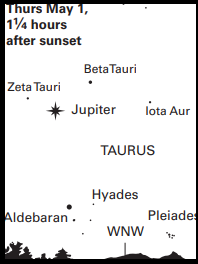
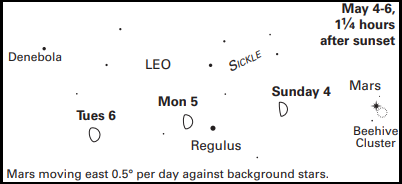
Boxes will say how many hours after sunset or before sunrise to look at the sky. Check your local sunrise and sunset times to know when to look. Some boxes show the sky for a single day, or for multiple days at the same time.
A box with a landscape along the lower edge shows the lower portion of the sky from the horizon up. Along the landscape you will see which direction to look is labeled. An illustration without a landscape shows a higher portion of the sky. At the date and time indicated in the day box, face the appropriate direction, and compare the illustration to what you see in the sky.
Additional information boxes will provide dates and times for moon phases, equinoxes, solstices, and other key astronomical dates.
The boxes will frequently have short notes of interesting phenomena you can observe with the naked eye. For instance, the Moon or the bright planets (Venus, Jupiter, and, occasionally Mars) can serve as useful guides to find objects of lesser brightness.
Most events depicted in the boxes are visible to the unaided eye. in certain situations such as when two objects appear close together and one is significantly brighter than the other or when objects are close to the horizon during twilight, binoculars can be helpful. The boxes will indicate when to try using binoculars.
The side column of the Sky Calendar will also provide additional notes and summaries of what to look for throughout the month as well as other useful resources. If you see an animal in one of the boxes, that means it is a planetarium staff member's birthday and that is one of their favorite animals.
Planets and the Moon
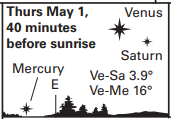
Planets are frequently highlighted in the Sky Calendar since their brightness and position frequently changes. They are found along an imaginary line called the ecliptic that represents the approximate plane of the solar system. As you follow the planets, you'll notice they occasionally pass one another, and the Sky Calendar indicated their separation in degrees. The naked-eye planets (Mercury, Venus, Mars, Jupiter, and Saturn) are represented by a spiky star icon with the size indicating relative brightness. Uranus and and Neptune require binoculars and are represented by a small plus sign to indicate where to look.
The Moon's position and appearance changes significantly each day. As you attempt to observe the Moon daily, you'll often spot it near one of the five naked-eye planets or bright stars. Occasionally, the moon will pass in front of a bright star and this is called an occultation. You have to be at the right latitude to see this happen. Keep an eye out for lunar and solar eclipses.
Other Phenomena
The Sky Calendar is written three months at a time and focuses on predictable changes and positions of objects. Meteor showers that happen each year at the same time are noted in the Sky Calendar. The are many different meteor showers and only the most prolific and brightest showers are highlighted.
Comets are not typically added to the Sky Calendar for several reasons. Many comets are very faint until they are close to the Sun and are not known far enough in advance to include during the production of the Sky Calendar. Even when they are known, comets are volatile and fickle. Some will brighten unexpectedly and others that start bright will break apart and fade from view.
The Sky Map on the Back
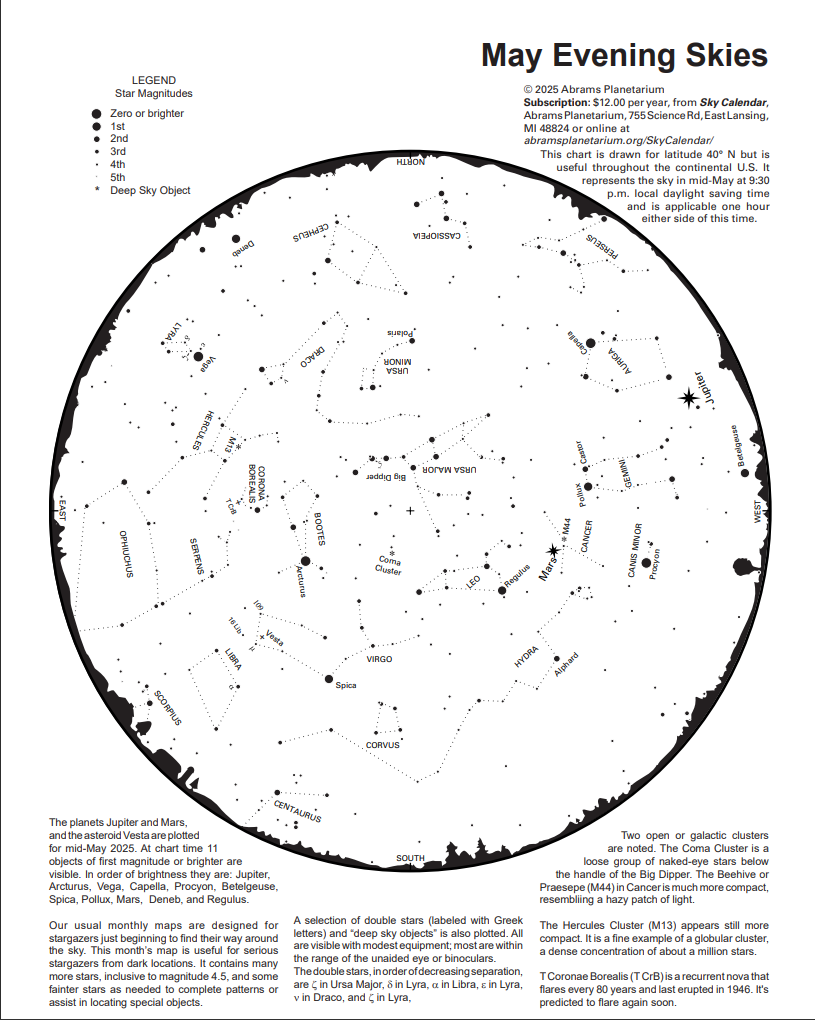
On the back of every month you will find a round diagram of the entire sky. There are six different sized stars indicating the magnitude of the star from zero to 5th magnitude. Magnitude is a backwards system with the smaller the number meaning a brighter star. You should be able to see the brightest stars in most locations. In towns and small cities you will likely only see down to a magnitude of about 3. In the country you should be able to see down to 5th magnitude.
Constellation lines are drawn as dotted lines. Constellations are labeled in all capital letters and stars are labeled with only the first letter capitalized. Around the circumference of the circle you will see the landscape. This outer edge shows objects near the horizon. There is a plus sign in the middle that indicates the zenith, the highest point in the sky directly overhead. The map will indicate for which time it was drawn for for each month. The sky shifts about 15 degrees westward every hour, so it is still useful for other times, just know the sky will be slightly shifted.
The cardinal directions are noted along the horizon on the map. You will notice that east and west are flipped compared to a standard map. This is because the map is meant to be held above your head. When you hold it so you can see the map as you look up, with North facing North, you will see East and West are properly aligned.
Additional notes of what to look for are also on the back.