Display Accessibility Tools

Accessibility Tools

Grayscale

Highlight Links

Change Contrast

Increase Text Size

Increase Letter Spacing

Readability Bar

Dyslexia Friendly Font

Increase Cursor Size

Sensory Friendly

 Sunday, October 18th, 2026

Image of an observatory

Big Astronomy

11:30 a.m.

Cartoon of little girl looking at floating lights

Beyond the Sun

1:00 p.m.


About Our Sensory Friendly Shows

The Abrams Planetarium offers sensory friendly shows on the third Sunday of every month at 11:30 a.m. and 1:00 p.m. These shows will run with the lights up, the sound down, and the theater doors open so people can move about as needed. We also provide a place to "chill out" in our lobby. All shows include a live star talk about what is up in the sky that night. We will include a short break between the main show and star talk. Information about what to expect during the show will be provided when you check in. 


Tickets & Pricing

Sensory friendly shows are free for all audiences!                                                     
We're sorry, but sensory friendly show tickets are not available in advance. Ticket availability begins 30 minutes prior to showtime and are available at the front door.


Season Schedule (Fall 2026 - Summer 2027)

The Abrams Planetarium sensory friendly show schedule for Fall 2026 through Summer 2027. Each show is approximately 60 minutes long; a 30 minute recorded portion followed by a 30 minute live presentation of the current evening sky.


Image of an observatory

Big Astronomy

11:30 a.m.
It takes many people with diverse backgrounds, talents, and skills to run a world-class observatory. Meet a few of these people as they share the wonder of the sky--and the excitement of discovery. Explore the world-class observatories nestled in northern Chile’s mountains and learn why Chile, is an ideal environment for studying the cosmos.
Video camera with text that reads "Show Trailer."
Paper and Pencil symbol with text that reads "Instructional Materials"
Cartoon of little girl looking at floating lights

Beyond the Sun

1:00 p.m.

While going to sleep, Celeste is visited by a friendly particle of light called Moon. Together, they travel beyond the Sun in search of new worlds and enjoy the delights and mysteries of exoplanet hunting. Find out how to detect exoplanets with Celeste and Moon and learn about all the different types of worlds including rogue planets, oceanic worlds and super-Earths. Even more, learn about real-life exoplanet hunters who observe the sky and search for other planets that are like Earth.

Paper and Pencil symbol with text that reads "Instructional Materials"
 
Anishinaabe constellations over a water background.

Living in Balance

11:30 a.m.
Living in Balance: Anishinaabe Star Knowledge highlights Anishinaabe stories of constellations and moons in relation to contemporary insights about environmental changes. Teachings shared by Native Skywatchers Carl Gawboy, William Wilson, and Dr. Annette S. Lee are narrated by Aarin Dokum with Anishinaabemowin translations by Alphonse Pitawanakwat set to art by Elizabeth LaPensée. 
Black box with text reading"Bad Astronomy." The text is surrounded by a scorpion, movie film, and a UFO.

Bad Astronomy

1:00 p.m.

Were the Apollo visits to the Moon actually a hoax? Have aliens landed on Earth? Can you tell your future by the stars? Prepare to debunk and tackle pseudoscience head-on with this planetarium show. Based on the popular book and website of the same name, this show offers a unique and fun approach to learning about the cosmos. Join the "Bad Astronomer" Phil Plait as he takes a critical look at popular myths and misconceptions to show audiences how science can be used to evaluate questionable claims.

Paper and Pencil symbol with text that reads "Instructional Materials"
 
Decorated Christmas tree with wreath.

Season of Light

11:30 a.m.
Many of the familiar customs that we observe this time of year have an astronomical connection. Our holiday offering explores the traditions that we associate with this special season.
Snow globe with tree, snowman, people, cat, and a rocking horse inside. Above is a gift box, tree, candy cane, Santa's sleigh, and constellations.

Christmas Constellations

1:00 p.m.

When we look at the stars, we can play a giant game of dot-to-dot. We can use our imaginations to come up with amazing things from basic shapes to mythical creatures to our favorite animals. In this show, we will use our imaginations for a search through the stars for holiday themed shapes in the sky. This show is suitable for preschoolers, young elementary aged children, and their families.

Sunset over a beach with seagulls flying.

Seasons and the Moon

11:30 a.m.
Listen to stories of the stars told by Native American Master Storytellers. In this show, you will hear two stories. "Spring Defeats Winter" retold by Joseph Bruchac (Abenaki) and "The Girl Who Married the Moon" retold by Gayle Ross (Cherokee).
Paper and Pencil symbol with text that reads "Instructional Materials"
Four stars, each with faces. Their colors are: red, blue, white, and yellow.

The Little Star That Could

1:00 p.m.

The story about an average yellow star on a search for planets of his own to warm and protect. Along his way, he encounters other stars, learns what makes each star special, and discovers that stars can combine to form clusters and galaxies. Eventually, Little Star finds his planets, and each is introduced to audiences along with basic information about the Solar System.

Video camera with text that reads "Show Trailer."
Paper and Pencil symbol with text that reads "Instructional Materials"
Satellite view of African continent with stars in background.

Skywatchers of Africa

11:30 a.m.
For thousands of years, Africans have used their knowledge of the sky to build their societies, shape their spiritual lives, and meet their physical needs for survival. Skywatchers of Africa highlights the diversity of African astronomy, examines cultural uses of the sky that developed throughout history, and celebrates our shared human experience.
Elmo, Big Bird, and Hu Hu Zhu pointing at the stars in the night sky.

One World, One Sky

1:00 p.m.

You don't need a spaceship to learn about the sun, moon, and stars-just a little imagination! When Big Bird, Elmo, and their friend from China, Hu Hu Zhu, take an imaginary trip to the moon, they learn amazing things along the way.

Paper and Pencil symbol with text that reads "Instructional Materials"
 
Sillouette of a person in front of an image of the Moon.

Imagine the Moon

11:30 a.m.
Explore how the Moon has inspired human creativity, learning, and exploration ever since we have looked to the sky. Each discovery has brought new opportunities to contemplate and imagine, until, driven by dreams, we left Earth and went there in the amazing journeys that culminated in astronauts walking on the Moon. People have imagined the Moon as a glowing disk in the sky, a destination in space, and a world that shares its origin with the Earth. The power of human imagination continues to inspire our relationship with the Moon as our partner in space and companion in our sky.
Video camera with text that reads "Show Trailer."
 
Platform floating over Earth with cartoon characters hanging off of a rail. Jupiter, Venus, Saturn, Mars, and Neptune are in the background with constellations between them.

The Great Solar System Adventure

1:00 p.m.

Join showman extraordinaire “The Great Schiaparelli” as he takes the audience on a death-defying space-time adventure within his wondrous Observatorium. From the sun-scorched surface of Mercury to the icy expanses of Pluto and beyond, prepare to be subjected to the myriad dangers and wonders of our Solar System, on a breathtaking tour that reveals just how precious our home planet really is. Be warned though, the Observatorium isn’t just for show. It will transport the audience right to the heart of some of the deadliest locations in our slice of the heavens. It’s going to take some fancy flying to get everyone back in one piece!

Two glowing orbs with gravitational waves eminating from them.

Unveiling the Invisible Universe

11:30 a.m.
For thousands of years humans observed the light coming from the night sky with their eyes. In the beginning of the 17th century, the invention of the telescope by Galileo revolutionized our knowledge of the Universe. Finally, in the 20th century with the advent of rockets, it became possible to go above the earth's atmosphere and observe X-ray and gamma ray radiation which are the marks of the hot and violent Universe. But it is not only light that can give us information about the cosmos. Neutrinos and cosmic rays also provide vital information. Finally, the detection by the LIGO experiment of gravitational waves from two merging black holes opened a new window in astrophysics. This show presents images of the cosmos as revealed by all these different messengers.
Galileo in front of a nebulous cloud of stars.

Two Small Pieces of Glass

1:00 p.m.

Learn how the telescope has helped us understand our place in space and continue to expand our understanding of the Universe. Explore the history of the telescope and the discoveries these wonderful tools have made. See how telescopes work and how the largest observatories in the world use them. View the Galilean Moons, Saturn's rings, and spiral structure of galaxies. Learn about the discoveries of Galileo, Huygens, Newton, Hubble, and others.

Video camera with text that reads "Show Trailer."
Paper and Pencil symbol with text that reads "Instructional Materials"
Canoe with sails on water.

Wayfinders

11:30 a.m.
This full-dome program puts you on the deck of the voyaging canoe Hōkūleʻa as you explore the nearly lost art and science of non-instrument navigation in Hawaiʻi and the Pacific. Produced by Bishop Museum in collaboration with Polynesian Voyaging Society and 1001 Stories. 
Cartoon character in a top hat and suit with a mustache standing infront of red curtains. In the background is a nebula.

We Are Stars

1:00 p.m.
What are we made of? Where did it all come from? Explore the secrets of our cosmic chemistry, and our explosive origins. Connect life on Earth to the evolution of the Universe by following the formation of Hydrogen atoms to the synthesis of Carbon, and the molecules for life. Narrated by Andy Serkis.
Video camera with text that reads "Show Trailer."
Paper and Pencil symbol with text that reads "Instructional Materials"
Photo of an observatory under a clear sky with stars

Messengers of Time and Space

11:30 a.m.
This planetarium show highlights how Gemini will work together with observatories that monitor the night sky for exciting astronomical events that change with time, like Rubin Observatory. Sometimes, light is not the only indicator of these short-term events. Audiences will learn how information can reach us through other messengers like cosmic rays, elusive particles called neutrinos, and even gravitational waves rippling through the Universe.
Video camera with text that reads "Show Trailer."
Paper and Pencil symbol with text that reads "Instructional Materials"
House, shed, doghouse, and trees underneath night sky with constellations.

In My Backyard

1:00 p.m.
Join children's entertainer Fred Penner as he explores things large and small, from the colors of the rainbow, to the reasons for the seasons. Through the use of entertaining songs and immersive environments, children are encouraged to participate while learning about the planets, constellations, meteors, the moon and more.
Mayan pyramid with glowing Moon above.

Mayan Archaeoastronomy

11:30 a.m.
In a feast of colors and sounds, this show takes a tour of 6 Mayan temples: San Gervasio, Chichen Itzá, Uxmal, Edzná, Palenque and Bonampak where the spectator dives into a Mayan world of knowledge about the importance of the orientations of its temples in relation to the movement of some stars like the Sun, the Moon and Venus. 
Video camera with text that reads "Show Trailer."
 
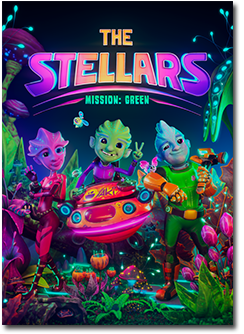
Cartoon of three aliens smiling in a lush forest

The Stellars

1:00 p.m.

Introducing THE STELLARS, a show designed with the youngest audiences in mind. The show weaves important educational themes into a character-driven story. It is the perfect blend of fun and learning, carefully crafted to spark the imagination and curiosity of young kids. The characters even break the “fourth wall” several times to directly engage with the audience about their ideas. The educational content of the show explores the essentials necessary for plant growth, the diversity of Earth's ecosystems, and the critical role of forests as habitats. It underscores our bond with nature and our role in preserving it, along with the importance of the scientific method in understanding our world. 


Parking

Available parking is dependent on the time of your visit:
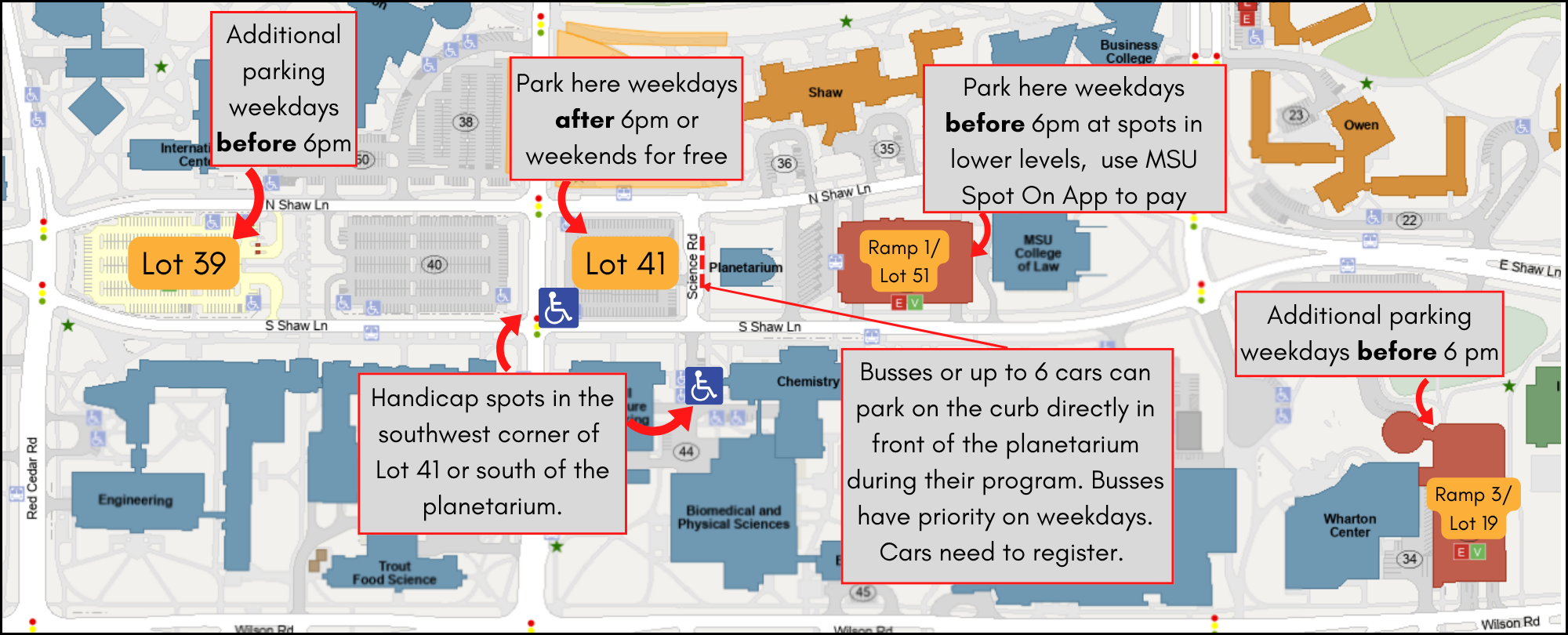
Map showing parking available near the planetarium.

Cars on Weekends or Weekdays after 6 p.m.

The lot directly across the street from the planetarium, Lot 41, is free and available to park. This lot is not available to park in weekdays before 6pm.
 

Cars on Weekdays before 6 p.m.

The closest spot to park cars on weekdays is the ramp behind the planetarium, Lot 51. Use the entrances on North or South Shaw lane farther from the planetarium/closer to the Law school to access the basement floors. These spots are metered. You can pay, using your license plate number, on the MSU Spot On app or at the kiosks. If those are full, Lot 39 or the Wharton Center, Lot 19,  are the next closest lots. For more information about Pay by Plate, please visit the MSU Parking Services website.


Virtual Tour


Visit - Learn - Discover MSU

Michigan State University is full of exciting places for your group to visit, learn, and discover. Now you can find many of them in one spot, where over a dozen destinations are just waiting to be explored. Rediscover a favorite or try something new!
Green box with text that reads "Visit Learn Discover."