Display Accessibility Tools

Accessibility Tools

Grayscale

Highlight Links

Change Contrast

Increase Text Size

Increase Letter Spacing

Readability Bar

Dyslexia Friendly Font

Increase Cursor Size

Home School Days

Wednesday, October 7th, 2026

Cartoon of three aliens smiling in a lush forest

The Stellars

Introducing THE STELLARS, a show designed with the youngest audiences in mind. The show weaves important educational themes into a character-driven story. It is the perfect blend of fun and learning, carefully crafted to spark the imagination and curiosity of young kids. The characters even break the “fourth wall” several times to directly engage with the audience about their ideas. The educational content of the show explores the essentials necessary for plant growth, the diversity of Earth's ecosystems, and the critical role of forests as habitats. It underscores our bond with nature and our role in preserving it, along with the importance of the scientific method in understanding our world. 


About Our Home School Days

Are you a home schooler who would like to visit the Abrams Planetarium? We've scheduled shows on the first Wednesday of each month of the 2026/2027 school year just for you! These shows start at 1:30 p.m, and last approximately one hour.

You are always welcome to call and reserve other show times, but these dates are open to anyone with no reservation needed and no minimum group size charge.


Tickets and Pricing

Tickets for home school days are sold at the gift counter, starting at 1:00 p.m. Showtimes are at 1:30 p.m. and there is no late seating allowed. Tickets are $3 per person.


Adult Supervision

This is not a drop-off program. All students must be accompanied by an adult and supervised at all times. Parents and chaperones also must buy a ticket for $3.00. Children under two years of age will be admitted at no cost, but we strongly suggest children under two years of age stay home. If a child becomes noisy and disruptive, we may ask that you leave the planetarium theater. 
 

Season Schedule (Fall 2026 - Summer 2027)

The Abrams Planetarium home school show schedule for the rest of the 2026/2027 school year. Each show is approximately 60 minutes long; a 30 minute recorded portion followed by a 30 minute live presentation of the current evening sky. The recommended grades given for the below shows are our recommendations based on the show's content. However, students of all ages will be permitted to any of the shows. 

Cartoon of three aliens smiling in a lush forest

The Stellars

Introducing THE STELLARS, a show designed with the youngest audiences in mind. The show weaves important educational themes into a character-driven story. It is the perfect blend of fun and learning, carefully crafted to spark the imagination and curiosity of young kids. The characters even break the “fourth wall” several times to directly engage with the audience about their ideas. The educational content of the show explores the essentials necessary for plant growth, the diversity of Earth's ecosystems, and the critical role of forests as habitats. It underscores our bond with nature and our role in preserving it, along with the importance of the scientific method in understanding our world. 

Grades: K - 3rd

Table setting with periodic table and a galaxy pictured above.

The Cosmic Recipe

Pull up a chair at our Planetarium’s Periodic Table and learn the cosmic recipes that created everything in our world-even us! Discover how the Big Bang and the stars have cooked up the everyday elements we interact with every day-like the calcium in our teeth, the silicon in our smartphones, and even the carbon in our apple pies. Explore the world of chemistry-the protons, neutrons and electrons! See how tiny atoms relate to the mammoth stars! Connect the physical worlds of the small and large in this engaging and inspiring show.

Grades: 6th and up

Snow globe with tree, snowman, people, cat, and a rocking horse inside. Above is a gift box, tree, candy cane, Santa's sleigh, and constellations.

Christmas Constellations

When we look at the stars, we can play a giant game of dot-to-dot. We can use our imaginations to come up with amazing things from basic shapes to mythical creatures to our favorite animals. In this show, we will use our imaginations for a search through the stars for holiday themed shapes in the sky. This show is suitable for preschoolers, young elementary aged children, and their families.

Grades: K - 3rd

Two observatory domes underneath a night sky with stars.

Big Astronomy

It takes many people with diverse backgrounds, talents, and skills to run a world-class observatory. Meet a few of these people as they share the wonder of the sky--and the excitement of discovery. Explore the world-class observatories nestled in northern Chile’s mountains and learn why Chile, is an ideal environment for studying the cosmos.

Grades: 5th and up

Four stars, each with faces. Their colors are: red, blue, white, and yellow.

The Little Star That Could

The story about an average yellow star on a search for planets of his own to warm and protect. Along his way, he encounters other stars, learns what makes each star special, and discovers that stars can combine to form clusters and galaxies. Eventually, Little Star finds his planets, and each is introduced to audiences along with basic information about the Solar System.

Grades: 2nd - 5th

The Sun.

Sunstruck

Discover the wonders of our sun. Its incredible energy has supported life on earth for millennia, but is now threatening our technology and way of life. Travel to the distant future to discover our sun's connection to the universe's cosmic cycle of life and death. 

Grades: 6th and up

Young girl sitting on a bed and playing with dinosaur toys. Dinosaurs look in at her through a window in the background.

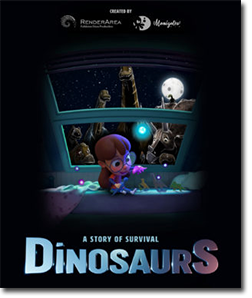
Dinosaurs

Like almost all children, Celeste is fascinated with dinosaurs. She is preparing a talk for her class about how they went extinct when Moon, a very wise and magical character, poses a tantalizing question: what if I told you that there are still dinosaurs among us? Celeste will join Moon in a journey through time. An exciting adventure that will show them the Earth as it was in the very, very distant past. They will see the fascinating transformations that these animals underwent over millions of years, creating giant creatures, armored beasts and super predators, until the day that a cataclysmic impact event caused a mass extinction on Earth. But all is not lost. Celeste will discover the key to their survival.

Grades: 1st - 5th

Aurora over mountains.

Experience the Aurora

Over seven months in the Arctic Circle, our crews captured timelapse images of the Aurora Borealis with high resolution digital SLR cameras outfitted with fisheye lenses. The results are spectacular. For the first time the aurora has been captured as it was meant to be experienced, as a display that covers the entire sky. This immersive show shares the science behind the aurora and tells the story of our quest to find and photograph the aurora for wraparound display in fulldome theaters. 

Grades: 6th and up

Girl sitting on her bed while looking at small floating bright lights. In the background is a large window with the night sky and a large planet.

Beyond the Sun

While going to sleep, Celeste is visited by a friendly particle of light called Moon. Together, they travel beyond the Sun in search of new worlds and enjoy the delights and mysteries of exoplanet hunting. Find out how to detect exoplanets with Celeste and Moon and learn about all the different types of worlds including rogue planets, oceanic worlds and super-Earths. Even more, learn about real-life exoplanet hunters who observe the sky and search for other planets that are like Earth.

Grades: 1st - 5th


Parking

Available parking is dependent on the time of your visit:

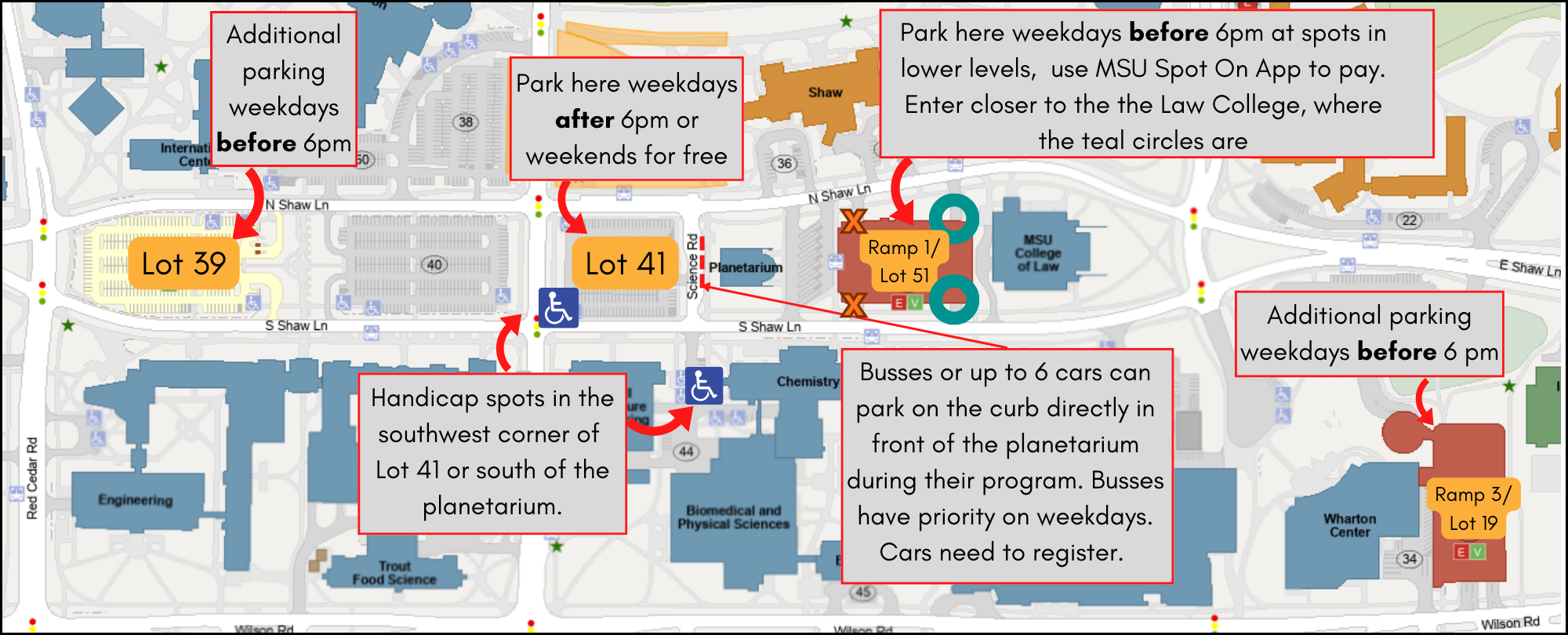
Map near MSU's campus showing various locations you can park

Cars on Weekdays before 6 p.m.

The closest spot to park cars on weekdays is the ramp behind the planetarium, Lot 51. Use the entrances on North or South Shaw lane farther from the planetarium/closer to the Law school to access the basement floors. These spots are metered. You can pay, using your license plate number, on the MSU Spot On app or at the kiosks. If those are full, Lot 39 or the Wharton Center, Lot 19,  are the next closest lots. For more information about Pay by Plate, please visit the MSU Parking Services website.
 

Cars on Weekends or Weekdays after 6 p.m.

The lot directly across the street from the planetarium, Lot 41, is free and available to park. This lot is not available to park in weekdays before 6pm.


Virtual Tour


Visit - Learn - Discover MSU

Michigan State University is full of exciting places for your group to visit, learn, and discover. Now you can find many of them in one spot, where over a dozen destinations are just waiting to be explored. Rediscover a favorite or try something new!
Green box with text that reads "Visit Learn Discover."